



I still remember the first industrial property I walked through back in 2014: a 47,000-square-foot distribution warehouse on the outskirts of Dallas with 28-foot clear heights and a single tenant on a triple-net lease. The numbers were almost boring in how consistent they were. That deal returned 9.2% cash-on-cash in year one, and by the time I exited five years later, the cap rate had compressed nearly 150 basis points. Industrial real estate investing has been the backbone of my portfolio ever since, and today the thesis is stronger than it has ever been.
The industrial sector has outperformed every other commercial real estate asset class over the past decade, and the structural forces driving that outperformance are not slowing down. E-commerce penetration continues to climb. Onshoring and nearshoring are reshaping North American supply chains. Cold chain logistics is expanding at double-digit rates. According to Prologis Research, the U.S. industrial market absorbed over 350 million square feet in 2025 alone, and vacancy rates in top-tier logistics corridors remain below 4%. If you are a serious investor looking to deploy capital into tangible, income-producing assets, industrial real estate deserves a prominent allocation in your portfolio. This guide breaks down exactly how to do it.
If you are new to commercial property ownership, start with our foundational guide on commercial real estate investing before diving into the specifics of the industrial sector below.
What is Industrial Real Estate Investing?
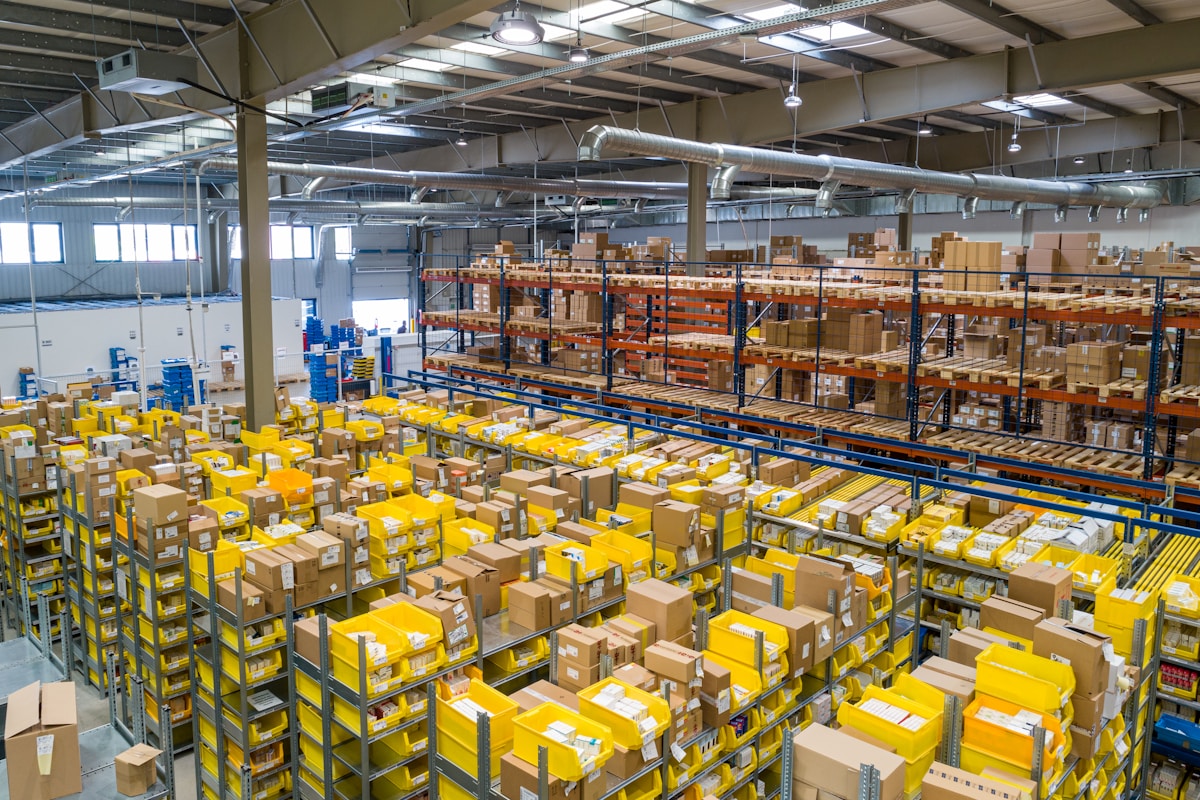
Industrial real estate investing is the acquisition, development, or financing of properties used for warehousing, manufacturing, distribution, logistics, and related industrial activities. These are the buildings that keep the modern economy running: the fulfillment centers that ship your online orders overnight, the cold storage facilities that preserve perishable goods across the food supply chain, and the manufacturing plants that produce everything from semiconductors to building materials.
What makes industrial uniquely attractive compared to office or retail is the simplicity of the physical structure and the mission-critical nature of the use case. An industrial tenant cannot easily work from home. Their business depends on physical space with specific functional characteristics, which creates sticky tenancy, predictable cash flow, and a durable demand profile that has proven resilient through multiple economic cycles.

The 5 Core Industrial Property Types
Not all industrial properties are created equal. Each subtype serves a distinct function in the supply chain, carries a different risk profile, and attracts different tenant classes. Understanding these distinctions is essential before you underwrite your first deal. Here is how I categorize the industrial universe.
Bulk Distribution Warehouses
These are the large-footprint facilities, typically 200,000 square feet and above, that serve as regional distribution hubs for major retailers, third-party logistics providers (3PLs), and e-commerce operators. They are usually located along interstate corridors near major population centers, with access to intermodal transportation (rail, highway, and sometimes port or air). Clear heights of 32 to 40 feet are now standard for new construction, allowing for high-density racking systems and robotic automation.
From an investment standpoint, bulk distribution warehouses offer the most institutional-quality cash flow in the industrial sector. Tenants sign leases of seven to fifteen years, and because the cost of relocating a distribution operation is enormous, tenant retention rates consistently exceed 70%. The trade-off is that these assets trade at the tightest cap rates, often 4.5% to 5.5% in primary markets, so your yield-on-cost strategy matters enormously. I look for assets in secondary logistics hubs like the Inland Empire, Central Pennsylvania, or the I-85 corridor in the Southeast where cap rates offer an additional 75 to 150 basis points of spread over gateway markets.
Manufacturing Facilities
Manufacturing properties are purpose-built for production activities and often feature specialized infrastructure: heavy power capacity (2,000+ amps), reinforced flooring for heavy machinery, overhead cranes, extensive HVAC systems, and environmental controls. These range from food processing plants to automotive parts fabrication to pharmaceutical production.
The investment thesis here hinges on the reshoring trend. Federal incentives from the CHIPS Act and Inflation Reduction Act have triggered a wave of domestic manufacturing investment. The tenants are creditworthy and the leases are long, but these assets carry higher functional obsolescence risk because the improvements are so tenant-specific. When a manufacturing tenant vacates, the re-tenanting cost can be substantial. I underwrite manufacturing deals with a sharp focus on the adaptability of the building shell and the creditworthiness of the tenant. If the structure can be converted to general warehousing at a reasonable cost, the downside is manageable.
Flex Industrial / R&D Space
Flex space combines warehouse or light industrial functionality with a meaningful office component, usually 25% to 50% of the total square footage. These properties are popular with small to mid-size companies that need a single location for their administrative team, product development lab, and light assembly or shipping operation. Think biotech startups, electronics firms, specialty food producers, and regional service companies.
Flex industrial is often overlooked by larger institutional investors, which creates opportunity for private investors. Multi-tenant flex parks in strong suburban employment centers can deliver cash-on-cash returns of 7% to 10% because the tenant base is diversified and the smaller bay sizes (5,000 to 20,000 square feet) command higher per-square-foot rents than bulk warehouse space. The management intensity is higher since you are dealing with more tenants and more turnover, but the rent premium compensates for it. Make sure to run your numbers carefully using a thorough deal analysis framework before committing capital.
Last-Mile Delivery Facilities
Last-mile facilities are the most exciting growth story in industrial real estate right now. These are smaller warehouses, typically 50,000 to 150,000 square feet, located within dense urban and suburban infill areas as close to the end consumer as possible. Their purpose is to enable same-day and next-day delivery, and the major e-commerce and grocery delivery platforms are competing aggressively for this space.
The economics of last-mile are compelling. Because these properties sit on scarce infill land where new supply is nearly impossible to build due to zoning restrictions and land costs, they command rent premiums of 20% to 40% over suburban bulk warehouse space. Vacancy in well-located last-mile submarkets has been effectively zero in markets like Northern New Jersey, South Florida, and the San Francisco Bay Area. The challenge is sourcing these deals since competition is fierce and pricing reflects the scarcity premium. I have had the most success acquiring older, underutilized light industrial buildings in infill locations and repositioning them for last-mile use, which allows you to capture significant value-add upside.
Cold Storage and Refrigerated Warehouses
Cold storage is a specialized niche within industrial that requires significant capital investment in refrigeration infrastructure but rewards investors with premium rents and exceptionally sticky tenants. These facilities maintain temperature-controlled environments ranging from 35 degrees Fahrenheit for produce and dairy down to negative 20 degrees for frozen goods and pharmaceuticals.
The supply-demand imbalance in cold storage is severe. According to CBRE’s U.S. Cold Storage Report, cold storage capacity has not kept pace with the explosion in online grocery, meal kit delivery, and pharmaceutical cold chain requirements. Approximately 75% of the existing cold storage inventory in the U.S. is over 25 years old, creating a massive modernization opportunity. Rents for modern cold storage run $12 to $20 per square foot triple-net, compared to $6 to $9 for conventional dry warehouse space. The barrier to entry is high since construction costs for cold storage run $250 to $350 per square foot versus $80 to $120 for dry warehouse, but that barrier is precisely what protects your investment from oversupply.
4 Structural Demand Drivers Behind Industrial Real Estate
Understanding why industrial real estate is outperforming is just as important as understanding what to buy. These are not cyclical trends. They are structural shifts in the global economy that will sustain industrial demand for years to come.
E-Commerce Growth and Fulfillment Infrastructure
E-commerce sales in the U.S. surpassed $1.2 trillion in 2025 and continue to grow at roughly 10% annually. Every billion dollars of incremental e-commerce revenue requires an estimated 1.25 million square feet of additional warehouse space. This is not speculation. It is math. Online retail requires roughly three times the logistics footprint of brick-and-mortar retail because of the complexity of direct-to-consumer fulfillment: picking, packing, shipping individual orders, and processing a high volume of returns. As long as consumers continue shifting spending online, the demand for industrial space will compound. For investors who want to understand how e-commerce intersects with broader CRE market research, the correlation between online retail penetration and warehouse absorption is one of the most reliable leading indicators in the sector.
Supply Chain Restructuring and Onshoring
The pandemic exposed the fragility of just-in-time global supply chains, and corporations responded by fundamentally restructuring their logistics networks. The playbook has shifted from efficiency-at-all-costs to resilience-first. Companies are holding more inventory closer to the point of consumption, which directly translates to greater demand for domestic warehouse space. Simultaneously, federal incentives are accelerating the onshoring and nearshoring of manufacturing. Semiconductor fabrication, electric vehicle battery production, pharmaceutical manufacturing, and advanced materials are all building out domestic production capacity at a pace not seen in decades. Each new manufacturing facility generates demand for upstream raw materials storage and downstream distribution space.
The On-Demand Economy and Speed-to-Consumer
Consumer expectations around delivery speed have permanently reset. Same-day and next-day delivery are no longer premium services. They are baseline expectations. This shift has forced retailers, grocers, and logistics providers to build out distributed networks of smaller fulfillment nodes positioned deep within metropolitan areas. The operational model requires a hub-and-spoke network: large bulk distribution centers feed inventory to regional sort centers, which in turn supply last-mile delivery stations. Each node in this network is an industrial property, and the network is still being built out across most U.S. markets.
Cold Chain Expansion and Food Safety Regulation
The cold chain, meaning the temperature-controlled supply chain for perishable goods, is expanding rapidly due to the convergence of online grocery adoption, pharmaceutical biologics growth, and increasingly stringent food safety regulations. The FDA’s Food Safety Modernization Act requires enhanced traceability and temperature monitoring throughout the food supply chain, which is driving demand for modern, compliant cold storage facilities. Simultaneously, the rise of GLP-1 and other biologic drugs that require cold chain distribution is creating new pharmaceutical demand for specialized refrigerated and frozen storage. This is a multi-decade demand driver with very limited existing supply to absorb it.


Pros and Cons of Industrial Real Estate Investing
Before deploying capital, you need to understand both sides of the ledger. Industrial has earned its reputation as a resilient asset class, but it is not without risk. Here is an honest assessment.
| Pros | Cons |
|---|---|
| Long-term NNN leases (7-15 years) with built-in rent escalations provide predictable cash flow | Cap rate compression in primary markets has pushed entry prices to record highs |
| Low management intensity compared to multifamily or retail; tenants handle maintenance under NNN structure | New supply in some markets (Phoenix, Dallas, Atlanta) has temporarily elevated vacancy above historical averages |
| Strong tenant retention rates (70%+) due to high relocation costs | Specialized properties (cold storage, manufacturing) carry functional obsolescence risk if the tenant vacates |
| Structural demand drivers (e-commerce, onshoring) are multi-decade tailwinds | Environmental liability exposure from prior industrial use requires thorough Phase I and Phase II assessments |
| Industrial rents have annual escalators of 3-4%, providing a natural inflation hedge | Rising construction costs and interest rates can squeeze development margins and refinancing economics |
| Favorable depreciation and cost segregation opportunities accelerate tax benefits | Single-tenant assets carry binary occupancy risk: either 100% occupied or 100% vacant |
How to Invest in Industrial Real Estate: A Step-by-Step Framework
I have bought industrial properties as a direct owner, as a limited partner in syndications, and through joint ventures with operating partners. The approach that works best depends on your capital base, time commitment, and expertise. Here is the framework I use regardless of the acquisition structure.
Step 1: Define Your Investment Criteria
Before you look at a single listing, get clear on your parameters. What is your target hold period? What cash-on-cash return do you need? Are you looking for stabilized core assets with lower returns and lower risk, or value-add opportunities where you can force appreciation through lease-up, renovation, or repositioning? I recommend new industrial investors start with stabilized, single-tenant NNN warehouse assets in the $2 million to $10 million range. The cash flow is predictable, the management burden is minimal, and you learn the asset class without taking on excessive execution risk.
Step 2: Identify Target Markets and Submarkets
Market selection drives the majority of your return in industrial. Focus on logistics corridors with strong population growth, proximity to major transportation infrastructure (interstates, ports, rail, airports), a favorable regulatory environment, and constrained land supply. Top-performing industrial markets consistently include the Inland Empire (Southern California), Central New Jersey, the I-85 corridor (Charlotte to Atlanta), the I-4 corridor (Tampa to Orlando), Dallas-Fort Worth, and the Lehigh Valley in Pennsylvania. Within each metro, drill down to the submarket level since a 15-mile difference in location can mean a 200-basis-point difference in cap rate. Our detailed guide on market research for commercial real estate covers the data sources and analytical frameworks you need for this step.
Step 3: Underwrite Conservatively and Stress-Test Assumptions
Industrial underwriting is relatively straightforward compared to more management-intensive asset classes, but that simplicity can breed overconfidence. For every deal, I model three scenarios: a base case using current market rents and a realistic lease-up timeline, a downside case assuming a 12 to 18-month vacancy after the current lease expires with a 15% rent reduction, and an upside case with market rent growth at 3% to 4% annually. Key metrics to evaluate include the going-in cap rate, cash-on-cash return, debt service coverage ratio (DSCR above 1.25x minimum), and the internal rate of return (IRR) over your projected hold period. Walk through our commercial real estate deal analysis methodology to make sure you are not leaving anything out of your model.
Step 4: Secure Financing and Close
Industrial properties are viewed favorably by lenders due to the stability of the asset class. Conventional commercial mortgages, CMBS loans, SBA 504 loans, and bridge financing are all viable options depending on the deal profile. Stabilized assets with strong tenants can typically secure 65% to 75% loan-to-value ratios at competitive rates. Value-add deals may require bridge financing at higher rates with a plan to refinance into permanent debt after stabilization. For a comprehensive overview of your options, read our guide on commercial real estate financing. Understanding how to use leverage effectively is critical since the right debt structure can boost your equity returns by 300 to 500 basis points, but overleveraging in a rising rate environment can wipe out your cash flow.
Maximizing Returns on Industrial Investments
Buying right is only half the equation. Active asset management separates the investors who earn market-rate returns from those who consistently outperform. Here are the value creation levers I focus on with every industrial property I own.
Lease structure optimization. Push for annual rent escalators of 3% or higher, structure leases as absolute NNN to minimize operating expense exposure, and negotiate early renewal options with mark-to-market rent resets. A well-structured lease is your most powerful tool for value creation because every dollar of incremental NOI is capitalized at a multiple.
Physical improvements that drive rent. Adding dock-high doors, increasing clear height through truss modifications, upgrading electrical capacity, installing LED lighting, or adding trailer parking can meaningfully increase the functional utility of a property and justify rent increases of 10% to 25%. These are relatively low-cost improvements compared to the NOI they generate.
Tax strategy. Conduct a cost segregation study immediately after acquisition to accelerate depreciation and generate substantial year-one tax losses. On a $5 million industrial acquisition, a cost segregation study can reclassify 20% to 35% of the purchase price into shorter-lived asset categories, generating $200,000 to $400,000 in accelerated depreciation in the first year alone. When it is time to sell, use a 1031 exchange or other exit strategy to defer capital gains and redeploy equity into a larger asset. For a deeper dive into return optimization tactics, see our guide on maximizing ROI on commercial real estate.
Key Risks to Manage in Industrial Real Estate
No asset class is risk-free, and industrial is no exception. The investors who consistently win are the ones who identify risks early and structure deals to mitigate them. Here are the primary risks I evaluate on every industrial acquisition.
Oversupply in select markets. Developers delivered a record volume of speculative industrial space in 2023 and 2024, and some markets are still absorbing that inventory. Markets like Phoenix, Dallas, and parts of Atlanta have seen vacancy climb from sub-3% to 7% or higher in certain submarkets. This does not invalidate the long-term thesis, but it means you need to be disciplined about market selection and avoid chasing deals in oversupplied corridors. According to JLL’s Industrial Market Statistics, national vacancy has stabilized and net absorption is trending positive, but the recovery is uneven across markets.
Environmental contamination. Industrial properties carry inherent environmental risk from prior uses. Always conduct a Phase I Environmental Site Assessment, and if any recognized environmental conditions are identified, proceed to a Phase II assessment with soil and groundwater sampling. Environmental remediation costs can be catastrophic if not identified before closing. I treat environmental due diligence as non-negotiable on every industrial deal, regardless of the property’s apparent condition.
Single-tenant concentration. Many industrial properties are leased to a single tenant, which means your occupancy is binary. If the tenant vacates or defaults, you go from 100% occupied to zero overnight. Mitigate this risk by focusing on creditworthy tenants with investment-grade ratings, securing longer lease terms with renewal options, and building a reserve fund equal to at least 12 months of debt service to weather a vacancy period.
Interest rate and refinancing risk. If you acquire a property with floating-rate or short-term debt, rising interest rates can erode your cash flow or create a refinancing gap at maturity. Always stress-test your debt structure against a 200-basis-point rate increase and consider interest rate caps or swaps to hedge exposure on floating-rate loans.
Frequently Asked Questions About Industrial Real Estate Investing
What is a good cap rate for industrial real estate?
Cap rates for industrial properties vary significantly by market, asset quality, and tenant credit. In primary logistics markets like the Inland Empire or Northern New Jersey, stabilized Class A warehouses trade at 4.5% to 5.5% cap rates. Secondary markets offer 5.5% to 7.0%, and value-add or Class B/C assets can trade at 6.5% to 8.5%. As a rule of thumb, I look for a going-in cap rate that provides at least a 200-basis-point spread over my cost of debt to ensure positive leverage from day one.
How much capital do I need to invest in industrial real estate?
For direct ownership of a small industrial property, plan on a minimum equity investment of $500,000 to $1 million, which can control a $2 million to $4 million asset with conventional financing. If you want exposure with less capital, industrial-focused real estate syndications and private equity funds typically have minimums of $50,000 to $250,000 for accredited investors. REITs like Prologis or Rexford Industrial offer liquid exposure with no minimum beyond the share price.
Is industrial real estate a good investment in 2026?
Yes, with discipline around market selection and pricing. The structural demand drivers, including e-commerce, supply chain restructuring, and cold chain expansion, remain intact and are multi-decade in nature. The near-term risk is that some markets have experienced a supply surge that has temporarily elevated vacancy. The opportunity is that this softening has created buying opportunities in select submarkets where pricing has adjusted but the long-term fundamentals remain strong. Investors who are disciplined about buying below replacement cost in well-located submarkets are positioned to generate strong risk-adjusted returns over a five to ten-year hold period.
What is the difference between NNN and gross leases in industrial?
In a triple-net (NNN) lease, the tenant pays all operating expenses: property taxes, insurance, and maintenance costs in addition to base rent. The landlord receives a clean, predictable income stream with minimal management burden. In a gross lease, the landlord pays operating expenses and builds those costs into a higher base rent. The vast majority of industrial leases, particularly for single-tenant warehouse and distribution properties, are structured as NNN. This is one of the key advantages of the asset class since your net operating income is highly predictable and your exposure to operating cost inflation is minimized.
How do I find off-market industrial deals?
The best industrial deals rarely hit the open market. Build relationships with local industrial brokers who specialize in your target submarkets since they see deal flow before it goes to a broader audience. Direct outreach to property owners through mail campaigns, cold calling, and door knocking can uncover motivated sellers. Attend local CCIM, SIOR, and NAIOP events to build your network. I have sourced several of my best acquisitions through relationships with 1031 exchange intermediaries who have clients with tight exchange timelines and motivation to transact quickly.
The Bottom Line on Industrial Real Estate Investing
Industrial real estate investing offers a rare combination in commercial real estate: strong structural demand, predictable cash flow from long-term NNN leases, low management intensity, and multiple value creation levers that reward active ownership. The sector is not without risk, and the days of buying anything with a loading dock and printing money are behind us. But for investors who approach the market with discipline, conduct rigorous underwriting, select the right markets, and actively manage their assets, industrial real estate remains one of the highest-conviction plays in the entire CRE landscape.
Start by defining your investment criteria, identifying two or three target markets with strong logistics fundamentals, and building relationships with specialized industrial brokers. Whether you enter through a direct acquisition, a syndication, or a joint venture, the key is to get started and begin building your knowledge base through real deal experience. The supply chain is not going back to the way it was, and the investors who own the physical infrastructure of modern commerce are going to be very well positioned for the decade ahead.


